
Fontein
Philip Aguirre y Otegui
1996

Details
- Collection: Open air depot, The collection
- Material: bronze
- Acquisition method: commision
- Object number: KIS.0123
Fontein (Fountain), a work by Philip Aguirre y Otegui, was installed in 1996 in the centre of Koolkaai. Both functional and aesthetic, this sculpture combines water and sculpture in a unique way, making it a striking feature in public space.
The work, entirely cast in bronze, consists of a round column, topped by a bowl serving as a drinking source. The overflowing water is caught in a lower rectangular basin, from whose narrow front edge it flows further down onto the ground. The sculpture was removed from Koolkaai in the early 2000s due to the constant risk of damage by local traffic. It is now safely stored in the open-air depot of the Antwerp public art collection at the Middelheim Museum, awaiting a new permanent location in the city.
Fontein (Fountain) is inspired by traditional water sources found in villages and cities around the world. Aguirre y Otegui reinterpreted this classical form and adapted it to the modern urban environment of Antwerp.
Philip Aguirre y Otegui (b. 1961) has produced a rich and diverse body of sculptures, drawings and prints. He is best known for his works in public space, which often engage in dialogue with architecture, history and social themes. His artistic language is restrained, archetypal and imbued with a humanist outlook.
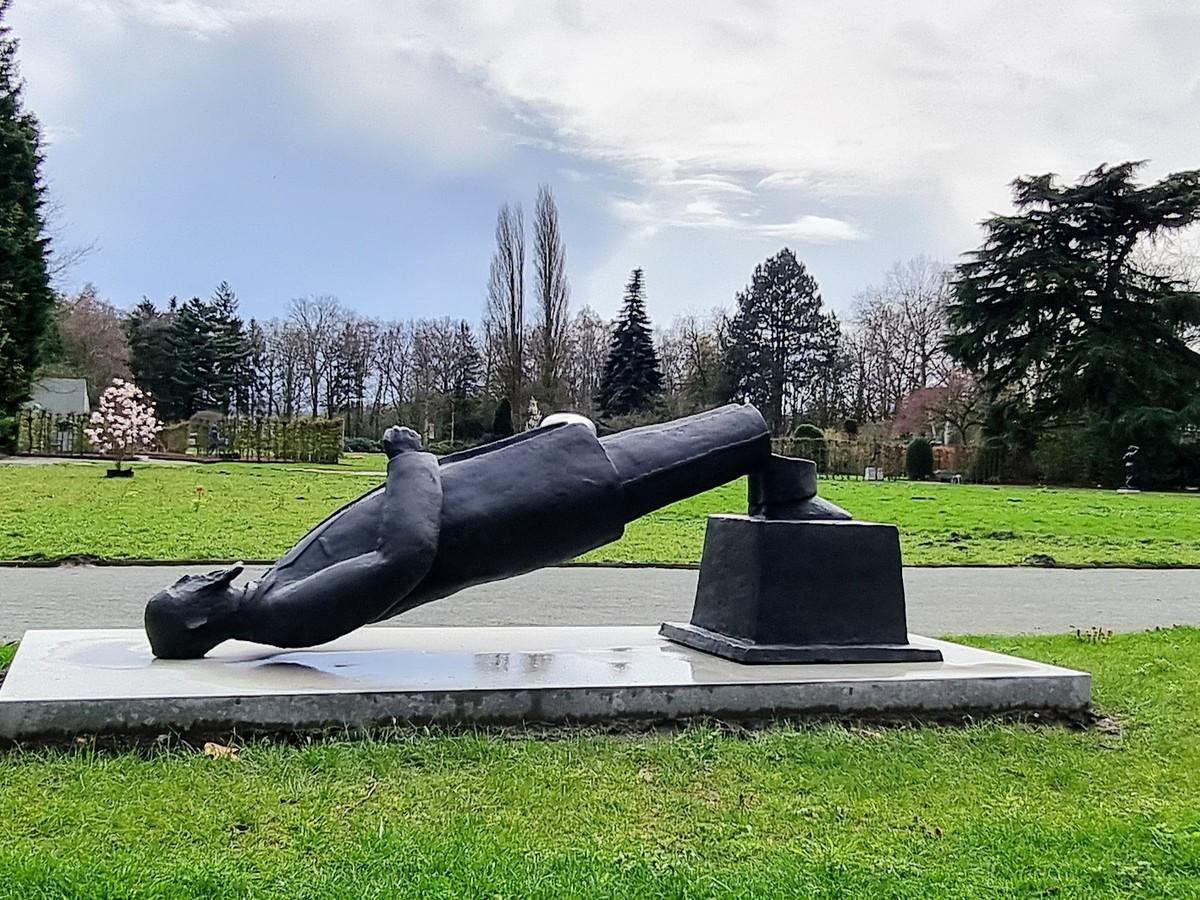
Alongside his autonomous works, such as Fallen Dictator at the Middelheim Museum – an anti-monument referencing the downfall of historical dictators – Aguirre y Otegui also creates monumental works in architectural contexts. His public interventions range from benches and school projects to urban installations that highlight the social role of art. A notable example of this is Théâtre Source, a water installation in Douala, Cameroon, which combines community-building with access to water. The model of this work is on display in the pavilion collection of the Middelheim Museum.
From the same artist
Philip Aguirre y Otegui
The stately bronze statue, with the external features of Belgium’s King Leopold II, has been sawed off at the ankles. The fallen leader lies on the ground beside his pedestal. The debates surrounding Belgian colonial history and television images of the overthrow of Iraqi dictator Saddam Hussein played an important role in the creation of this work. In his anti-monument, Philip Aguirre y Otegui has created a powerful, universal image of the dethroning of rulers who have gone off the rails.